
AN APPOINTMENT
Private, neutral-facilitated resolution of business disputes — including breach of contract, partnership disputes, and commercial relationship breakdowns — without litigation.
Key Takeaways
Contract and commercial mediation is a private, neutral-facilitated process that resolves business disputes — including breach of contract, partnership disputes, and commercial relationship breakdowns — without litigation. Parties ready to discuss a pending or potential dispute can contact Perkins Group, LLC directly to schedule a session.
Jud Perkins, founder of Perkins Group, LLC, in Salem, Connecticut, serves as a panellist in commercial disputes with the American Arbitration Association, the ADR Center of Connecticut, the National Center for Dispute Settlement and mediates in Rhode Island District Court.
Perkins Group, LLC resolves more than 85 percent of cases, typically within weeks rather than the months or years required by state court proceedings. The firm serves commercial parties in Connecticut, Rhode Island, Massachusetts, and the New York City area.
Contract and commercial mediation is a confidential, structured negotiation process in which a neutral mediator facilitates discussion between disputing business parties to reach a voluntary settlement. The mediator does not decide who is right, issue a binding award, or impose a resolution. Parties retain full control over the outcome, which is finalised with a signed written settlement agreement.
Each state in which Perkins Group, LLC operates — Connecticut, Rhode Island, Massachusetts, and the New York City area — maintains statutory frameworks governing mediation agreements and ADR proceedings.
Business-to-business contracts across the Northeast regularly include mandatory ADR clauses requiring mediation before any arbitration or litigation can proceed.
| Dispute Resolution Method | Binding | Average Timeline | Privacy | Cost Level |
|---|---|---|---|---|
| Commercial Mediation | Yes (with settlement agreement) | Weeks | Fully private | Low |
| AAA Commercial Arbitration | Yes | Months | Private | Moderate to high |
| State Court Litigation | Yes | 1 to 3 years | Public record | High |
| Informal Negotiation | No | Variable | Private | Lowest |
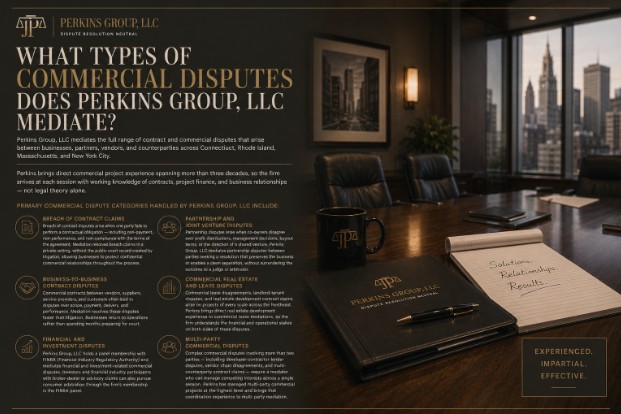
Perkins Group, LLC mediates the full range of contract and commercial disputes that arise between businesses, partners, vendors, and counterparties across Connecticut, Rhode Island, Massachusetts, and the New York City area.
Perkins brings direct commercial project experience spanning more than three decades, so the firm arrives at each session with working knowledge of contracts, project finance, and business relationships — not legal theory alone.
Primary commercial dispute categories handled by Perkins Group, LLC include:
1
Breach of contract disputes arise when one party fails to perform a contractual obligation — including non-payment, non-performance, and non-compliance with the terms of the agreement. Mediation resolves breach claims in a private setting, without the public court record created by litigation, allowing businesses to protect confidential commercial relationships throughout the process.
2
Partnership disputes arise when co-owners disagree over profit distributions, management decisions, buyout terms, or the direction of a shared venture. Perkins Group, LLC mediates partnership disputes between parties seeking a resolution that preserves the business or enables a clean separation, without surrendering the outcome to a judge or arbitrator.
3
Commercial contracts between vendors, suppliers, service providers, and customers often lead to disputes over scope, payment, delivery, and performance. Mediation resolves those disputes faster than litigation. Businesses return to operations rather than spending months preparing for court.
4
Commercial lease disagreements, landlord-tenant disputes, and real estate development contract claims arise on projects of every scale across the Northeast. Perkins brings direct real estate development experience to commercial lease mediations, so the firm understands the financial and operational stakes on both sides of those disputes.
5
Multi-party commercial disputes. Complex commercial disputes involving more than two parties — including developer-contractor-lender disputes, vendor chain disagreements, and multi-counterparty contract claims — require a mediator who can manage competing interests across a single session.
Perkins has managed multi-party commercial projects at the highest level and brings that coordination experience to multi-party mediation.
Commercial mediation produces better outcomes when the mediator understands the commercial environment in which the dispute arose. Perkins Group, LLC reports a successful resolution in more than 85% of mediated cases — a track record built on 35 years of managing large-scale commercial projects, not on a legal career alone.
Before founding Perkins Group, LLC, Perkins managed the development and operation of large-scale commercial projects across the United States, including Walt Disney World and Madison Square Garden.
Those projects required direct experience negotiating contracts, managing vendor and partner relationships, resolving payment disputes in real time, and delivering results under budget and schedule pressure.
Commercial parties bring those same issues to mediation, and the firm arrives already fluent in the language of agreements, project finance, and business relationships.
Perkins Group, LLC holds active panel membership with the following organizations: American Arbitration Association (AAA), ADR Center of Connecticut, FINRA (Financial Industry Regulatory Authority), The National Center for Dispute Settlement (NCDS), and Rhode Island Courts.
Commercial mediation follows a structured process that moves from pre-session preparation through joint discussion, private caucuses, and, when parties reach a resolution, a written settlement agreement.
1
The parties contact Perkins Group, LLC and agree to mediation. Each side submits a brief written statement outlining its position, the key contract terms or facts at issue, and the resolution sought. Perkins reviews those materials before the session begins, so time is not spent on introductory education.
2
All parties convene with Perkins in a joint session. Each side presents its position directly and without interruption. The joint session gives Perkins a direct read of each party's priorities, non-negotiables, and areas where movement is possible.
3
Perkins meets separately with each party. Parties speak candidly in caucus about real interests, financial constraints, and settlement parameters. Mediation communications are protected by each state's confidentiality statutes, so caucus disclosures cannot be used as evidence in any subsequent proceeding.
4
Perkins moves between parties, testing proposals and developing resolution options that each side can accept. Commercial background allows Perkins to evaluate financially realistic solutions — not just positional compromises — so parties leave with agreements that reflect the actual economics of the dispute.
5
When parties reach a resolution, they execute a written settlement agreement before the session concludes. A signed mediation settlement is a binding contract enforceable in the appropriate state court.
Commercial disputes drain revenue with every month they stay unresolved — contact Perkins Group, LLC at (860) 204-9168 to schedule a mediation session.
Commercial mediation through Perkins Group, LLC costs less than AAA commercial arbitration or state court litigation for most disputes.
The American Arbitration Association publishes commercial arbitration fee schedules based on claim amount, with filing fees, arbitrator compensation, and case service fees that increase significantly as claim values rise.
State court litigation adds attorney fees, expert witness costs, and deposition expenses, and, in complex commercial matters, can extend case timelines by one to three years.
Mediation fees through Perkins Group, LLC are typically shared equally between the parties. Parties should contact Perkins Group, LLC directly at (860) 204-9168 to discuss the fee structure and scheduling.
Yes. Commercial mediation through Perkins Group, LLC is a confidential process. Each state in which the firm operates — Connecticut, Rhode Island, Massachusetts, and the New York City area — maintains statutory confidentiality protections for mediation communications.
Statements made in joint sessions, positions disclosed in private caucuses, and documents prepared specifically for mediation remain protected from disclosure unless all parties agree in writing to waive that protection.
Confidentiality provides commercial parties with a safe forum to discuss the real financial stakes of a dispute, allowing businesses to explore settlement ranges and acknowledge contract weaknesses without fear that such disclosures will appear in a subsequent arbitration or trial.
Commercial contracts frequently include mandatory ADR clauses requiring mediation before arbitration. Understanding the distinction between the two processes helps commercial parties make informed decisions about timing, cost, and control over outcomes.
Commercial mediation can be binding. Perkins facilitates discussion and helps parties reach a voluntary agreement. Either party can walk away at any point before signing. A settlement agreement binds the parties when reduced to a signed written agreement.
Commercial arbitration is binding. An arbitrator hears evidence, applies contract law and the governing state’s statutes, and issues an award enforceable in state court. Parties surrender final decision-making authority once arbitration proceedings begin.
Businesses facing high-value or multi-party disputes that cannot be resolved through mediation may need to proceed to complex commercial arbitration under the AAA’s Large, Complex Commercial Disputes procedures.
Perkins Group, LLC handles both commercial mediation and arbitration, providing parties with a single experienced neutral for either stage of the dispute resolution process.
Parties whose commercial disputes also involve construction claims — such as contractor payment disputes or development contract disagreements — can engage the firm for both tracks.
Common Questions
Contract and commercial mediation works best for breach-of-contract claims, partnership disputes, business-to-business payment disputes, and commercial lease disputes. Any matter in which confidentiality, speed, and the preservation of business relationships outweigh a binding adjudicated ruling is a strong candidate for mediation. Perkins Group, LLC mediates commercial disputes across Connecticut, Rhode Island, Massachusetts, and the New York City area.
No state universally requires mediation before commercial arbitration, but many business-to-business contracts include mandatory ADR clauses requiring mediation as a first step. Parties should review their specific contract language before filing any demand.
Commercial mediation through Perkins Group, LLC typically resolves in a single session of four to eight hours. Multi-party disputes or those with complex contract terms may require more than one session. A mediation session with Perkins Group, LLC takes days to weeks, compared to the months or years required by AAA arbitration or state court litigation.
A commercial mediation settlement becomes legally binding when parties execute a written settlement agreement at the close of the session. An oral agreement reached during mediation is not enforceable. Perkins ensures parties reduce any resolution to writing before the session concludes.
A neutral who served as a mediator is generally disqualified from serving as an arbitrator in the same matter under the AAA Commercial Arbitration Rules. Perkins Group, LLC provides both services but does not serve in dual roles on the same dispute. Parties anticipating both stages should discuss neutral selection with the firm at the outset.
Yes. Perkins Group, LLC mediates commercial and contract disputes in Connecticut, Rhode Island, Massachusetts, and the New York City area. Parties with multi-jurisdictional contract disputes or commercial relationships spanning those states should contact Perkins Group, LLC at (860) 204-9168 to discuss whether the firm is the right neutral for their matter.
In Commercial mediation the mediator facilitates discussion, and the parties decide the outcome which can then be formalized in contract form. Commercial arbitration is binding: the arbitrator hears evidence and issues an enforceable award under the governing state's arbitration statutes. Mediation costs less, concludes faster, and preserves business relationships more effectively than arbitration in most commercial disputes.
The right neutral turns a stalled dispute into a signed agreement — contact Perkins Group, LLC to discuss your commercial matter.